Pour-Over V60: How to Brew Filter Coffee by Hand
With a pour-over dripper like the Hario V60, you brew filter coffee without a machine and control every step yourself. This guide gives you a reliable base recipe that delivers a clean, clear cup from the very first brew.
What makes a pour-over dripper different
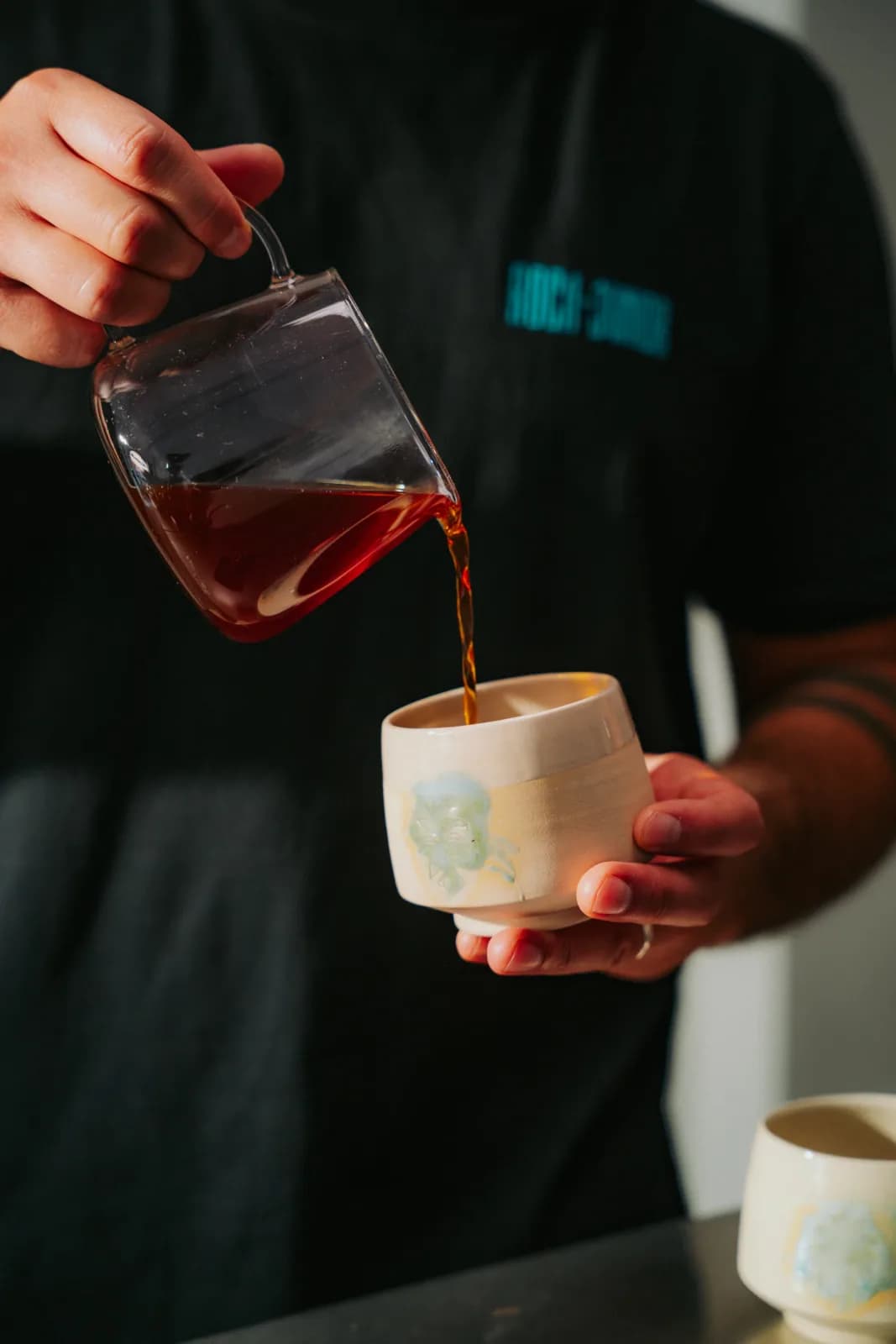
With pour-over, you pour hot water in several stages over ground coffee sitting in a paper filter. The water runs through the coffee bed, dissolves aromas and acids and drips into a carafe or cup. Unlike a drip machine, you decide the temperature, pouring speed and timing yourself.
The V60 is a cone with a 60-degree angle, spiral ribs on the inside wall and a large hole at the bottom. Water drains relatively quickly, so extraction depends heavily on how you pour. That makes it more demanding than flat-bottom drippers like the Kalita Wave, but it rewards you with plenty of clarity and control in the cup.
What you’ll need
- A V60 dripper (size 01 for one cup, 02 for up to three cups)
- Matching paper filters, for example Hario filters
- Freshly roasted coffee, ideally whole bean
- A grinder with conical or flat burrs
- A scale with a built-in timer, accurate to 0.1 g
- A kettle, ideally with temperature control, and a gooseneck pouring kettle
- A cup or carafe
The scale and gooseneck kettle aren’t gimmicks: without a scale you don’t know how much water you’ve already poured, and without a fine spout it’s almost impossible to control the stream.
The base recipe: 15 g to 250 ml
| Parameter | Value |
|---|---|
| Coffee | 15 g |
| Water | 250 g (ml) |
| Ratio | about 1:16.7 |
| Water temperature | 92–96 °C (198–205 °F) |
| Grind size | medium-fine, roughly like coarse sand |
| Bloom | 30–40 g water, 30–45 seconds |
| Total time | approx. 2:30–3:30 minutes |
This recipe is a starting point, not a fixed rule. Lighter roasts tend to like the upper end of the temperature range, darker roasts the lower end. If you want more body, nudge the dose up to 16 g with the same amount of water.
Step by step: brewing V60 filter coffee
- Bring the water to a boil and let it cool to 92–96 °C, or set your kettle to that temperature.
- Weigh out 15 g of coffee and grind it medium-fine, right before you brew.
- Fold the paper filter, place it in the V60 and rinse it thoroughly with hot water. This removes the papery taste and preheats the dripper and vessel. Discard the rinse water.
- Add the ground coffee to the filter, give it a gentle shake so the bed is level, and tare the scale.
- Start the timer and pour 30–40 g of water in circles so all the grounds are wet. This is the bloom: the coffee releases CO₂ and swells up. Wait 30–45 seconds.
- Pour in slow circles from the center outwards and back until the scale reads about 150 g. Try not to pour directly onto the filter wall.
- Let it drain down briefly, then keep pouring up to 250 g. All the water should be in the filter by about 1:45 minutes at the latest.
- Give the V60 one gentle swirl so the coffee bed settles flat.
- Let it drain. When the filter is empty, your total time should ideally be between 2:30 and 3:30 minutes.
- Remove the filter, give the coffee a quick swirl and let it cool for a few minutes. As it cools, sweetness and fruit notes become more pronounced.
Dialing in your grind by brew time
Total brew time is your most important clue. If the coffee drains much faster than 2:30 minutes and tastes thin or sharply sour, grind finer. If it takes longer than 3:30 minutes and the cup turns dry or bitter, grind coarser. Only change one variable at a time, otherwise you won’t know what made the difference.
Your pouring also affects the time: a hard stream from high up stirs up fine particles that can clog the filter. Pour low and steady instead. If the coffee still doesn’t taste right even though the time is on target, our guide to sour and bitter filter coffee will help.
Which coffee works best for pour-over
Any coffee will work, but pour-over really shines with light filter roasts. We roast fresh every week in small batches and source our green coffee directly from farmers we know well. Balanced coffees from Central and South America are a great place to start, such as Finca Matilde from Costa Rica. If you like floral and lively, reach for an Ethiopian coffee.
If you don’t have your own grinder, you can also order our coffees ground for filter. Freshly ground is still the better choice, though, because ground coffee loses its aroma faster.
Learn pour-over: the filter coffee course
At the Rocademy at Kreittmayrstraße 5 in Munich’s Maxvorstadt, we teach pour-over on the V60, the Origami and the Kalita. We cover grind size, water, brewing technique and timing, the exact variables from this guide, only with direct feedback. The filter coffee course costs €160 and is currently fully booked, but you can put your name down for the next date.
Frequently asked questions
How much coffee do I need for a V60?
A good starting point is 15 g of coffee to 250 ml of water, which works out to about 1:16.7. For several cups, scale both values up at the same ratio.
How long should a V60 brew take?
Including the bloom, the total time for one cup is usually between 2:30 and 3:30 minutes. If it runs faster, grind finer; if it takes longer, grind coarser.
Do I need to rinse the paper filter?
Yes. Rinsing removes the papery taste and preheats the dripper and vessel. Pour the rinse water away before you brew.
Can I make pour-over coffee without a scale?
You can, but it gets imprecise. The weight of a level tablespoon of beans varies a lot depending on the variety and roast. A simple kitchen scale with 0.1 g increments makes all the difference.